
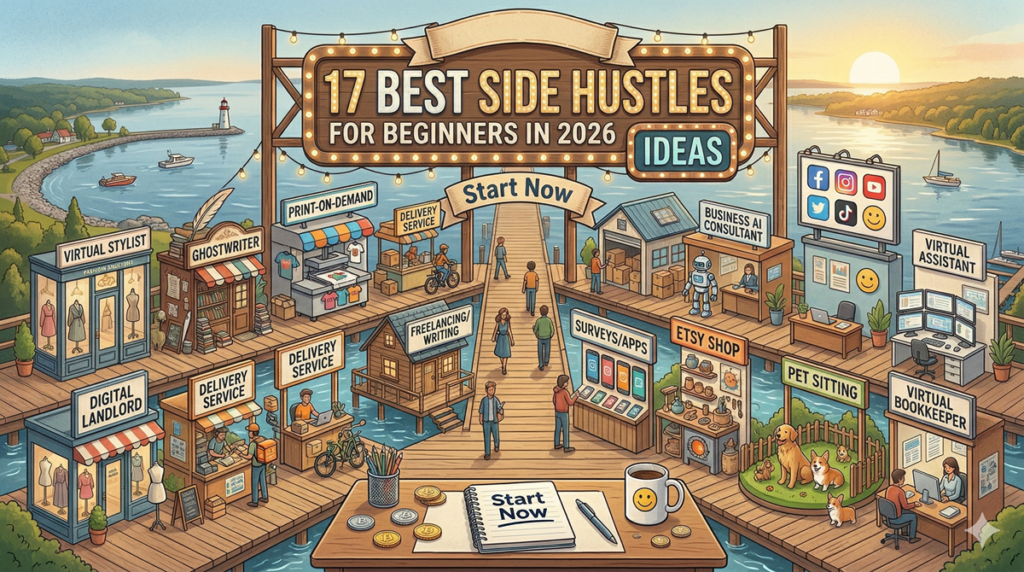
You can start a profitable side hustle in 2026 with little or no upfront cost and scale it to match your schedule and income goals. Pick options that fit your skills and time—freelance services, digital products, tutoring, and simple online gigs top the list for beginners. Many beginners earn $200–$2,000+ per month within a few months by focusing on one idea and consistently building clients or listings.
This guide breaks down 17 beginner-friendly side hustles, what each realistically pays, how much time and startup cost they need, and which platforms make getting started easiest. Use the short profiles and practical tips to pick one you can launch in the next 30–90 days.
Key Takeaways
- Choose a hustle that matches your skills and available time.
- Start small, focus on one option, and build consistency.
- Track earnings and legal basics early to scale safely.
What Is a Side Hustle?

A side hustle is work you do outside your main job to earn extra money, learn skills, or test business ideas. It usually fits around your schedule, requires low to moderate startup cost, and can scale if you choose.
Definition and Overview
A side hustle is a paid activity you run alongside full-time employment or studies. You keep your primary job as the main income source while taking on tasks that fit evenings, weekends, or flexible hours.
Common forms include freelance services (writing, design), gig work (rideshare, delivery), microbusinesses (selling digital products), and part-time in-person jobs. Startup costs vary from near-zero (freelance writing) to a few hundred dollars (basic e-commerce inventory or tools).
You retain control over when and how much you work. That control means you can prioritize high-rate tasks, set client limits, or automate parts of the process to reduce time spent.
Benefits of Side Hustles
You can increase monthly cash flow and build an emergency savings buffer without quitting your job. Many people earn an extra $500–$2,000+ per month depending on hours, skill level, and the chosen hustle.
Side hustles let you test business ideas before investing fully and help you learn practical skills like client management, marketing, and pricing. Those skills can improve your resume and lead to higher-paying opportunities.
You also gain flexibility: you choose projects and scale work to match life events. Risks include time management strain and tax implications, so track income and set aside taxes from the start.
Current Trends in 2026
Demand for remote freelance work remains strong, especially in writing, editing, design, and no-code development. Platforms and marketplaces have matured, making it easier to find clients and get paid securely.
Micro-entrepreneurship—selling digital courses, templates, and niche subscription content—continues to grow because of low overhead and high margins. AI tools accelerate production but raise competition; you must emphasize unique expertise or niche positioning.
Gig and hybrid models that combine remote and local work (e.g., local tutoring plus online lesson packages) show high scalability. Regulatory and platform changes affect earnings, so you should monitor terms and diversify income streams.
Choosing the Right Side Hustle for Beginners

Focus on measurable factors: what skills you can sell now, how many hours per week you can commit, and how much money you can invest upfront. Use those three criteria to quickly eliminate options that won’t fit your schedule, budget, or skill set.
Assessing Your Skills and Interests
List your marketable skills first — writing, basic design, Excel, customer service, tutoring, coding, or social media management. Rate each skill 1–5 for proficiency and 1–5 for enjoyment; prioritize skills with high scores in both columns.
Check past evidence: client feedback, completed projects, course certificates, or measurable outcomes (sales, traffic, grades). Those are stronger signals than vague confidence.
Match skills to clear entry-level gigs. For example, basic Excel and data cleanup map to remote data entry or spreadsheet gigs. Short-form writing and editing align with content mills or microtask platforms. If you lack marketable skills, pick a low-cost course (under $100) that yields a portfolio piece within 2–4 weeks.
Time Commitment Considerations
Decide how many hours per week you can reliably work: 3–5, 6–15, or 16+. Short windows (3–5 hours) favor gig work like microtasks, transcription, or selling digital products. Mid-range (6–15 hours) suits freelancing, virtual assistance, or tutoring. Above 16 hours lets you build scalable services or an online store.
Estimate time-to-first-dollar for each option. Microtasks and reselling often pay in days; freelancing and course creation take weeks. Track your actual time for two weeks before scaling. Use a simple table to compare:
- Hours available: 6/week
- Goal: $300/month
- Best fits: Freelance editing (2–4 jobs), tutoring (2 sessions/week)
Low Investment Options
Start with ideas that require minimal cash: freelance writing, social media posting, virtual assistance, microtask platforms, tutoring, or printables. Typical upfront costs: domain ($10–15/yr), basic freelance profile (free), or premium course ($50–100) if needed.
Protect your time: choose platforms with low fees and quick client access (Upwork, Fiverr, Tutor.com). Build a one-page portfolio or a 5-piece sample pack to show work. Reinvest early earnings into a simple website or targeted ads only after you have steady clients.

Top 17 Best Side Hustles for Beginners in 2026
You can start these side hustles with low upfront cost, clear skill paths, and flexible schedules. Each option lists typical pay ranges, essential tools, and quick steps to get your first client or gig.
Freelance Writing and Editing
Freelance writing pays anywhere from $0.03 to $1.00+ per word depending on niche and experience, or $20–$100+ per hour for editing and copyediting. You should choose a narrow niche—SaaS, personal finance, healthcare, or B2B—so you can charge more for subject-matter knowledge.
Build a portfolio with 3–5 strong clips: blog posts, case studies, or sample product descriptions. Use platforms like Upwork, Contently, and LinkedIn, and pitch directly to small companies and newsletters.
Essential tools: Google Docs, Grammarly or ProWritingAid, a simple website or portfolio PDF, and an invoice tool (Wave or FreshBooks). Set clear rates, deliverables, and rounds of revisions in written agreements to avoid scope creep.
Online Tutoring and Teaching
Online tutoring often pays $15–$60 per hour for general subjects and $30–$100+ per hour for test prep or specialized skills. Identify exam prep (SAT/ACT/GRE), K–12 subjects, or adult skills like Excel or coding to maximize demand.
List qualifications clearly: degrees, certifications, test scores, or sample lesson plans. Use marketplaces such as Wyzant, Preply, or Outschool, or teach on Udemy/Teachable for passive course income.
Essential tools: webcam, headset, Zoom or Google Meet, whiteboard app (Jamboard or Miro), and a scheduling/payments tool (Calendly + Stripe). Offer a free 20–30 minute trial to demonstrate value and convert recurring students.
Delivering with Gig Apps
Delivery driving or bicycling for apps (DoorDash, Uber Eats, Instacart) typically yields $10–$25+ per hour after expenses, varying by city, time, and tip rate. You can work evenings and weekends to capture peak demand.
Optimize earnings by batching orders, using hot zones, and tracking per-mile costs for taxes and fuel. Keep an insulated bag, phone mount, and simple route-planning app to increase efficiency.
Requirements: valid driver’s license or bike, insurance (check app rules), and a basic smartphone. Track mileage and incidentals with MileIQ or a spreadsheet; treat the work as a small business for tax deductions and quarterly estimated taxes.
Remote Customer Service
Remote customer service roles pay $12–$25 per hour depending on technical complexity and company size. You can provide chat support, email triage, or phone-based help from home. Emphasize soft skills: clear writing, patience, and concise problem resolution.
Find roles on remote job boards (We Work Remotely, Remote.co), company career pages, or staffing agencies. Prepare a one-page cheat sheet of product FAQs and sample responses to speed up onboarding.
Essential tools: reliable high-speed internet, noise-cancelling headset, quiet workspace, and familiarity with CRMs like Zendesk or Freshdesk. Document common issues and escalate templates to reduce handle time and improve customer satisfaction.
Digital and Online Side Hustles
You can launch most online hustles with under $200 and scale from part-time to full-time by reinvesting profits and using AI tools for efficiency. Focus on product-market fit, clear listing pages, and predictable marketing channels to see consistent results.
Selling Products on Marketplaces
Selling on marketplaces like Amazon, eBay, Etsy, and Walmart means you tap into built-in traffic but must optimize listings to compete. Use clear product titles, five to ten high-quality photos, and bullet-pointed feature lists. Track keywords with simple tools (Helium 10, eRank, or free search-inspector extensions) and A/B test titles and images to improve conversion.
Decide on fulfillment: handle shipping yourself (lower fees, more control) or use FBA/managed programs (faster delivery, higher fees). Factor in fees, return rates, and storage costs into your pricing to protect margins. Start with a narrow product line (3–10 SKUs) and expand based on sales data.
Use inventory spreadsheets and reorder alerts to avoid stockouts. Offer consistent customer service and request reviews from satisfied buyers; a 4.5+ rating increases visibility and conversion.
Dropshipping
Dropshipping removes the need to hold inventory by routing orders to suppliers who ship directly to customers. Choose reliable suppliers from platforms like AliExpress, CJ Dropshipping, or vetted US/EU partners for faster shipping and fewer returns. Validate product demand with small ad tests before scaling ad spend.
Profitability depends on tight ad control and niche selection. Aim for products with at least 30–40% gross margin after ad costs and marketplace/platform fees. Automate order processing with apps (Shopify integrations, Oberlo alternatives) to save time and reduce manual errors.
Manage customer expectations with clear shipping times and tracking. Have contingency plans for supplier issues and always maintain an accessible returns/refund policy to preserve your store’s reputation.
Print on Demand
Print on demand (POD) fits creators who want custom designs without inventory risk. Platforms like Printful, Printify, and Merch by Amazon handle production, printing, and shipping after a sale. Focus on niche designs where audiences are passionate—hobbies, professions, micro-communities—so you can target ads and organic social posts effectively.
Prioritize mockups, design quality, and accurate size charts to reduce returns. Price products to cover base cost, fulfillment fees, and marketing while keeping competitiveness. Use limited-run drops, seasonal collections, or bundles to increase average order value.
Leverage integrations with Etsy or Shopify to centralize listings and automate fulfillment. Track design performance and retire low-sellers; reinvest profits into your top 10% of designs that drive most revenue.
Affiliate Marketing
Affiliate marketing pays commissions for referring sales or leads. Choose reputable affiliate programs with transparent conversion tracking—Amazon Associates, ShareASale, Impact, and niche-specific programs are common starting points. Focus on high-intent content: product comparisons, how-to guides, and verified reviews that align with your audience’s needs.
Optimize your content for search and conversion: clear call-to-action buttons, disclosure of affiliate relationships, and performance-tracking using UTM parameters or affiliate dashboards. Aim for a mix of high-ticket and recurring-commission products to stabilize income.
Promote through a blog, YouTube, or niche email list rather than broad social posts alone. Build trust by testing products when possible and reporting real user outcomes; your credibility directly affects click-to-conversion rates.
Service-Based Side Hustles
You can start many service-based gigs with little or no upfront capital, reliable local demand, and tools you already own. Focus on clear pricing, insurance or bonding where needed, and simple ways to get repeat customers.
Pet Sitting and Dog Walking
Pet care pays consistently if you build trust. Offer specific services: 30-minute walks, overnight stays, home visits with photo updates, and medication administration. Set clear prices for weekdays, weekends, and holidays; charge extra for multiple pets or special needs.
Get insured or join platforms that provide insurance and background checks to reassure owners. Create a short client intake form with emergency contacts, vet info, feeding and exercise routines, and behavior notes. Use scheduling apps or a calendar to avoid double bookings and send automated payment reminders.
Market locally via neighborhood apps, vet bulletin boards, and social media groups. Ask satisfied clients for reviews and referrals, and consider packages (weekly walks) or subscription pricing to stabilize income.
Handyman or Task Services
Offer focused, billable skills rather than vague “odd jobs.” List the exact tasks you do: furniture assembly, mounting TVs, minor drywall repair, faucet replacement, yard cleanup, and appliance installation. Provide hourly rates plus parts markup or flat fees for common tasks to simplify quoting.
Carry a basic toolkit and a parts list for common small repairs to finish jobs in one visit. Photograph before-and-after work and keep receipts for materials; present simple written estimates and get client sign-off for extra work. Consider licensing or permits if local law requires them for certain services.
Use platform listings, local SEO, and community boards to attract customers. Offer a satisfaction guarantee for small jobs to reduce friction and encourage positive reviews.
House Cleaning Services
Define your cleaning packages clearly: standard 60–90 minute clean, deep clean, move-in/out clean, and add-ons like oven or refrigerator cleaning. Price by square footage or per-room plus extras for heavy-duty tasks. Provide a checklist for clients so expectations match the service delivered.
Bring or list the supplies you provide and note any eco-friendly options at a premium. Offer recurring scheduling discounts for weekly or biweekly clients and establish a cancellation policy to protect your time. Train to clean efficiently—work room-by-room with a fixed order to cut travel time inside the home.
Collect payments digitally and ask for repeat bookings on the last visit. Request reviews and permission to post before/after photos to build credibility.
Creative Side Hustles
You can turn artistic skills into steady income by offering services that clients routinely need: regular social posts, branded visuals, or event and product photos. Work can scale from one-off gigs to retainer contracts that pay predictably.
Content Creation for Social Media
You create short-form videos, carousel posts, and caption copy that match a brand’s voice and convert viewers into followers or customers. Focus on one platform first — TikTok, Instagram, or LinkedIn — and build a portfolio of 6–12 sample posts showing hooks, pacing, and call-to-action results.
Charge either per post, per package (e.g., 12 posts/month), or on a monthly retainer for content + scheduling. Use a simple rate sheet: hourly for strategy, flat for production, and extra for platform-specific editing. Tools to use: CapCut or Premiere for video, Canva/Photoshop for graphics, and Later or Buffer for scheduling.
Offer clear deliverables: number of posts, captions, hashtags, and one round of revisions. Track basic metrics (impressions, reach, saves) so you can show ROI in client conversations and raise rates once you have consistent engagement data.
Graphic Design Services
You design logos, social templates, PDFs, and marketing materials for small businesses and creators who need fast, polished visuals. Start with a focused niche — e.g., boutique salons, coaches, or indie authors — and assemble 8–10 ready-to-show mockups that reflect that audience.
Set pricing tiers: basic template edits, custom single projects, and brand kits (logo + color palette + 3 templates). Use Figma or Adobe Illustrator for source files and deliver both editable and flattened versions. Maintain a license checklist for stock assets to avoid legal issues.
Streamline intake with a brief that asks for style references, color preferences, and primary deliverables. Offer one or two revision rounds in your standard price and charge extra for rushed timelines or extended brand strategy work.
Photography Gigs
You shoot product photos, small event coverage, headshots, or lifestyle images for e-commerce listings and social feeds. Specialize in one area first to build a targeted portfolio — for example, product flat-lays for Etsy sellers or natural-light headshots for remote professionals.
Price by deliverable: per image for product shots, hourly plus a usage fee for commercial licensing, and package rates for events (hours + edited images). Use consistent editing presets in Lightroom to speed delivery and provide a clear usage/licensing agreement covering online and print rights.
Offer add-ons like simple retouching, background removal, or optimized crop sizes for specific platforms. Communicate turnaround time and file formats up front to set client expectations and reduce revision cycles.
Passive Income Side Hustles
You can build income that largely runs without daily oversight by choosing assets that pay dividends or by creating digital products that sell repeatedly. Both paths require upfront work or capital, but they scale differently and suit different risk tolerances.
Investing in Dividend Stocks
Dividend stocks pay regular cash distributions you can receive without selling shares. Focus on companies with a multi-year track record of increasing dividends, stable free cash flow, and payout ratios below 70% to reduce risk of cuts.
Open a low-cost brokerage or use a dividend-focused ETF if you prefer instant diversification. Reinvest dividends via a DRIP (dividend reinvestment plan) to compound returns, or take payouts as cash for passive income.
Monitor yield, payout growth, and balance-sheet strength quarterly. Taxes vary by account type and dividend classification (qualified vs. ordinary), so use tax-advantaged accounts (IRAs, Roth IRAs) when possible to improve after-tax income.
Creating and Selling Digital Products
Digital products—ebooks, templates, courses, stock photos, and plugins—sell repeatedly with minimal ongoing effort once created. Validate demand first: run a short survey, pre-sell a minimum viable product, or test ads to measure conversion before full development.
Choose a platform that fits pricing and delivery: marketplaces (Udemy, Gumroad), a personal site with Stripe, or subscription platforms for recurring revenue. Invest in quality—clear audio for courses, polished templates, and searchable metadata for discoverability.
Automate delivery, updates, and customer support where possible using email sequences, FAQ pages, and versioned downloads. Track metrics: conversion rate, customer acquisition cost, and lifetime value to decide when to iterate or scale.
Managing Your Side Hustle
You’ll need clear routines, firm boundaries, and measurable targets to keep a side hustle sustainable. Prioritize time, energy, and money so the gig grows without derailing your main job or health.
Balancing With a Full-Time Job
Block specific hours each week for your side hustle and treat them like nonnegotiable appointments. Use a calendar app with color-coded blocks: for example, two weeknight sessions (7–9 pm) and a three-hour weekend block. That prevents spillover into work hours and signals to family when you’re unavailable.
Automate where possible to reduce time drain. Schedule social posts, use invoicing templates, and set up email filters and canned replies. Delegate or outsource low-value tasks once revenue justifies it—hire a virtual assistant for admin or use a fulfillment service for product shipping.
Protect your primary job by avoiding conflicts of interest and following employer policies. Keep client communications off work devices and never use company time or proprietary resources. If your side hustle could overlap with employer business, consult HR or a lawyer first.
Avoiding Burnout
Track your weekly hours and energy, not just output. If you exceed 10–15 extra work hours consistently, cut back or restructure tasks. Insert short recovery rituals—15-minute walks, a tech-free hour before bed—to reset cognitive load.
Rotate task types to change mental strain. Mix creative work (writing, design) with administrative chores (emails, bookkeeping) so you’re not doing the same focused task for long stretches. Use the Pomodoro method or 45/15 work-break cycles to maintain focus without exhausting yourself.
Set firm stop times and enforce one full day off each week. Communicate boundaries to clients with clear service windows and response-time expectations. If you feel chronic fatigue, pause new client intake and reassess pricing or workflow before scaling.
Setting Realistic Goals
Define three measurable goals for the next 90 days—revenue target, client count, and a process improvement. Make goals specific, e.g., “earn $800/month, onboard two retainer clients, reduce admin time by 30% with templates.”
Break each goal into weekly tasks and assign deadlines. Use a simple tracking table:
- Goal: Earn $800/month
- Weekly tasks: 5 outreach emails, 3 proposals, 2 networking events
- Metric: Weekly leads and signed clients
Review progress every Sunday for 15 minutes. If you miss targets two weeks in a row, adjust the task list or the goal itself. Increase prices, refine your niche, or cut low-ROI tasks rather than widening scope indiscriminately.
Legal and Financial Considerations
You need to choose the right legal structure, keep clear financial records, and meet tax deadlines to avoid penalties and protect your personal assets. Below are the concrete steps and rules that matter most when you start earning from a side hustle.
Registering Your Side Hustle
Decide whether to operate as a sole proprietor, LLC, or S-corp based on liability and tax goals. A sole proprietorship is simplest—no formal registration in most states—but it does not separate your personal assets from business liabilities. Forming an LLC typically costs $50–$300 depending on state fees and provides personal liability protection; use your state’s Secretary of State website to file articles of organization.
Check local requirements: some cities/counties require a business license, home-occupation permit, or sales tax permit if you sell goods. If you plan to use a business name other than your legal name, register a DBA/Fictitious Name. Open a dedicated business bank account and get a business card to keep income and expenses separate for bookkeeping and audit defense.
Understanding Taxes for Side Hustlers
You must report all side-hustle income, even if platforms send a 1099-K only above reporting thresholds. Track gross receipts and deductible business expenses (supplies, software subscriptions, home office portion) using accounting software or a spreadsheet. If you earn $400+ in net self-employment income, you’ll likely owe self-employment tax (Social Security and Medicare) in addition to income tax.
Make estimated quarterly tax payments if you expect to owe $1,000+ at year-end. Use Form 1040-ES to calculate and pay federal estimated taxes and check your state revenue department for state estimated tax rules. Keep receipts and mileage logs for three to seven years and consider consulting a tax professional if you scale up, form an entity, or have complex deductions.
Conclusion
You now have 17 practical side hustles to choose from that fit different schedules, skills, and risk tolerance. Pick one or two that match what you enjoy and what you can commit to consistently.
Start small to test demand and refine your process before scaling. Track time, costs, and earnings so you can compare real results against your goals.
Leverage free tools and AI where appropriate to speed setup and reduce repetitive work. Invest modestly in learning that directly improves your ability to earn more.
If you need a quick decision aid, use this checklist:
- Interest: Do you enjoy the work?
- Market: Is there visible demand?
- Time: Can you commit regular hours?
- Cost: Are startup costs manageable?
Treat the first months as experiments. Expect gradual progress and make adjustments based on data, not guesswork.
Stay consistent, protect your time, and prioritize one task at a time. With steady effort, a side hustle can become a reliable income stream or evolve into something larger.